Inside Systems
The rules, roles, pressures, and incentives that shape what people do—and how their behavior gets interpreted.
Enter the systemTurning the Lens on the Thing Doing the Looking.
A behavior becomes a judgment. A judgment becomes a category. A category starts to stand in for a person.
CONTRARIWISE asks what happens when we turn the lens on the systems, assumptions, and observers doing the looking.
Explore the methodThe rules, roles, pressures, and incentives that shape what people do—and how their behavior gets interpreted.
Enter the systemWhat does it take to rebuild a self after incarceration, when the institutional identity keeps following you?
Explore reintegrationOrdinary encounters with extraordinary implications. Where a small moment reveals the machinery around it.
Read the notesThe person is in the picture.
So is the thing taking the picture.
“Why did they behave that way?” is a useful question. It also has a habit of making everything around the person disappear.
CONTRARIWISE begins by widening that question. Who named the behavior? What counted as normal, reasonable, cooperative, or risky? What conditions made this action possible—or made another action difficult? What does the observer’s role allow them to see?
Contrariwise turns the thing around and looks again.
Sometimes the rule is sensible. Sometimes the person resisting it is wrong. Sometimes consistency is exactly what fairness requires. CONTRARIWISE begins when the official explanation stops being enough.
If someone failed to comply, what did compliance require? If someone made a choice, what alternatives were actually available? If a worker says there was nothing else they could do, what did the role, policy, hierarchy, and risk make possible in that moment?
A missed appointment can be recorded as disengagement. That record may say nothing about a broken phone, a bus journey, a work shift, or a previous encounter that made asking for help feel dangerous. These possibilities do not tell us what happened. They tell us what we have yet to ask.
A worker interpreting behavior is also a person inside a system. Caseloads, deadlines, professional expectations, discretion, fear of mistakes, and the measures used to judge their work can shape the encounter. Turning the lens includes those pressures without making them an automatic excuse.
Context matters. Choices matter. Consequences matter. The task is to understand how they meet, rather than letting one neat label do all the explanatory work.
A fuller explanation is not an alibi.
Understanding pressure does not erase agency. Understanding resistance does not make resistance wise. People act inside conditions they did not choose, and their choices within those conditions still matter.
Try the methodThe person seeking help and the person administering it meet inside an architecture neither of them fully controls.
Appointments, forms, evidence, deadlines. What capacities does a process assume, and what happens when those assumptions become conditions of access?
Eligible. Noncompliant. High risk. Hard to serve. Examine who creates the category, what work it performs, and how it changes the options available to a person.
Professional roles carry expectations and constraints. Where do care, discretion, workload, liability, and institutional loyalty pull in different directions?
A closed file, a completed referral, an attendance rate. When a measure becomes the goal, what happens to the experience it was supposed to represent?
This inquiry crosses criminal justice, housing, behavioral health, and human services. The settings differ. The questions travel: who gets to define the problem, whose account becomes the record, and who lives with the consequences?
Release changes a person’s location. Rebuilding a life asks much more of them.
Outside the Gate explores the psychology of community reintegration: identity, agency, belonging, anticipated stigma, and the long reach of institutional experience. Its central question is what allows someone to reconstruct an identity after incarceration rather than simply carry the institutional identity into the community.
Identification, housing, income, treatment, and employment shape the room a person has to act. Trust, perceived control, self-belief, and belonging shape how that room is experienced. These are interacting parts of a life, rather than separate checklists.
A person may leave custody and encounter a world that still reads them through a conviction, a risk category, or a gap in their history. Reintegration raises questions about who has the power to recognise change—and what happens when a past identity remains the price of admission.
This developing research asks what a meaningful return to community looks like from within a person’s life. Safety and accountability belong in that inquiry, alongside participation, relationships, stability, and a sense of a possible future.
Working observations that start with an encounter, a phrase, or a routine—and ask what becomes visible around it.
Opening editorial notes. Conceptual examples, not client case records.
A process can have a clear ending while the person’s situation does not. The referral is sent. The case is closed. The required action is complete.
From the desk, this may be an accurate account of the work. From the other side of the desk, the person may still be trying to get through a door.
The point is to ask what completion means, whose endpoint it describes, and whether anyone is responsible for what happens between one service and the next.
The phrase sounds like a description of a person. But serving involves an encounter: a person, a service, a set of expectations, and the conditions under which they meet.
Someone can find a service difficult to reach, difficult to understand, or difficult to trust. A worker can find the same encounter difficult to sustain within the time and resources available.
Calling the person “hard to serve” settles the location of the difficulty before the relationship has been examined.
The calendar records an absence. It cannot, by itself, explain one.
An appointment at ten o’clock looks straightforward until we ask what has to remain stable for ten o’clock to stay available. The person has to receive the information, remember it, retain some control over transportation and work, and avoid a more urgent crisis displacing it.
For someone living with a reliable schedule and adequate resources, those assumptions may be invisible because they are routinely met. For someone living in instability, they may be the most difficult part of the requirement.
Institutions are organized around schedules. Crisis is organized around immediacy. Those are not the same clock.
A hypothetical missed appointment might involve a broken phone, a failed bus connection, a changed work shift, or an immediate threat to housing. It might also involve avoidance, refusal, or a choice the observer would disagree with. The empty time slot does not tell us which.
Unwillingness, inability, and overload can look remarkably similar from the outside. The administrative outcome may be identical, even when the reasons are not.
The first interpretation matters because it can shape the next response: an invitation, a warning, an exclusion, or another question. Before the absence becomes a verdict about the person, what do we know—and what have we filled in?
Adapted from the developing CONTRARIWISE manuscript, “Punishing Poverty.”
Examine a judgmentAn apparently simple judgment can contain an entire set of unexamined expectations. Open the record.
These questions do not establish what happened in any particular case. They create room to investigate it. A fuller account may still involve a harmful choice or a necessary boundary. It should also tell us how that conclusion was reached.
CONTRARIWISE examines human behavior inside systems—and the systems through which that behavior is understood.
It is an intellectual, research, and writing project at the intersection of social psychology, forensic psychology, criminal justice, housing instability, behavioral health, and human services. Power, stigma, identity, bureaucracy, and community reintegration run through the inquiry.
Its central method is to turn the lens on the thing doing the looking: the institution, category, professional role, assumption, power structure, or observer that shapes an interpretation.
The project develops through research, essays, field notes, and a book in progress. Each offers a different way to examine the relationship between a person and the terrain through which they have moved.
CONTRARIWISE is developed by Domenica Campbell, a practitioner with experience across criminal justice, corrections, behavioral health, child welfare, housing, and community services. She is completing a Master of Science in Psychology with an emphasis in Forensic Psychology at Grand Canyon University.
That practitioner perspective is part of the inquiry, and subject to it. Experience provides a place to begin asking questions; it does not place the observer outside the frame.
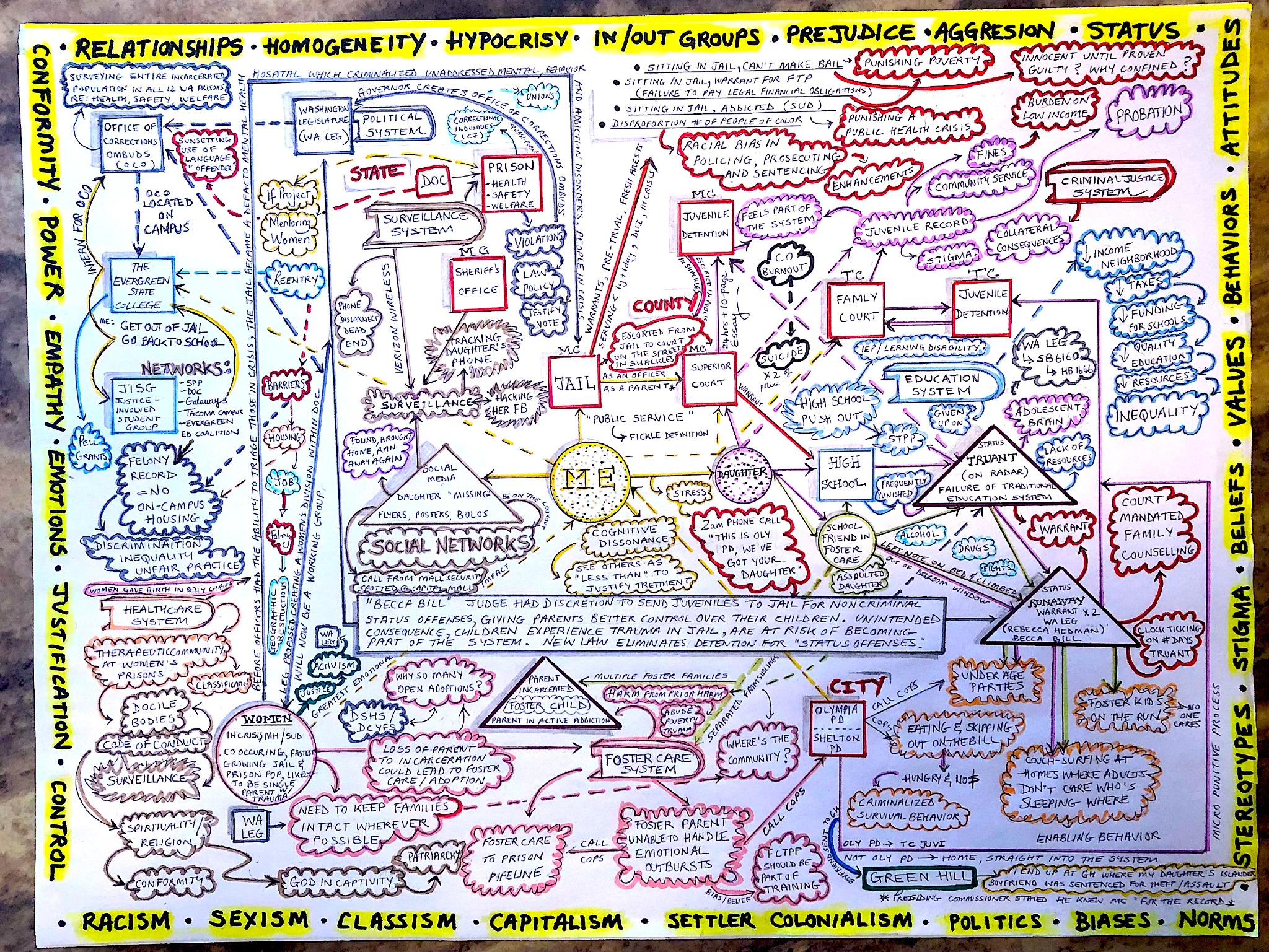
A hand-drawn mind map by Domenica Campbell, created in Spring 2019. At its centre sits “ME,” surrounded by institutions, relationships, identities, pressures, and experiences.
At the time, I thought I was mapping my life. Looking at it now, I think I was trying to map the self inside systems.
Corrections sits near education. Family collides with courts. Power, empathy, stigma, and control press in from the edges. The drawing records an inquiry before it had a name.
The person in the center was never the whole story.
From the developing CONTRARIWISE manuscript, “The Map Before I Knew What I Was Mapping.”
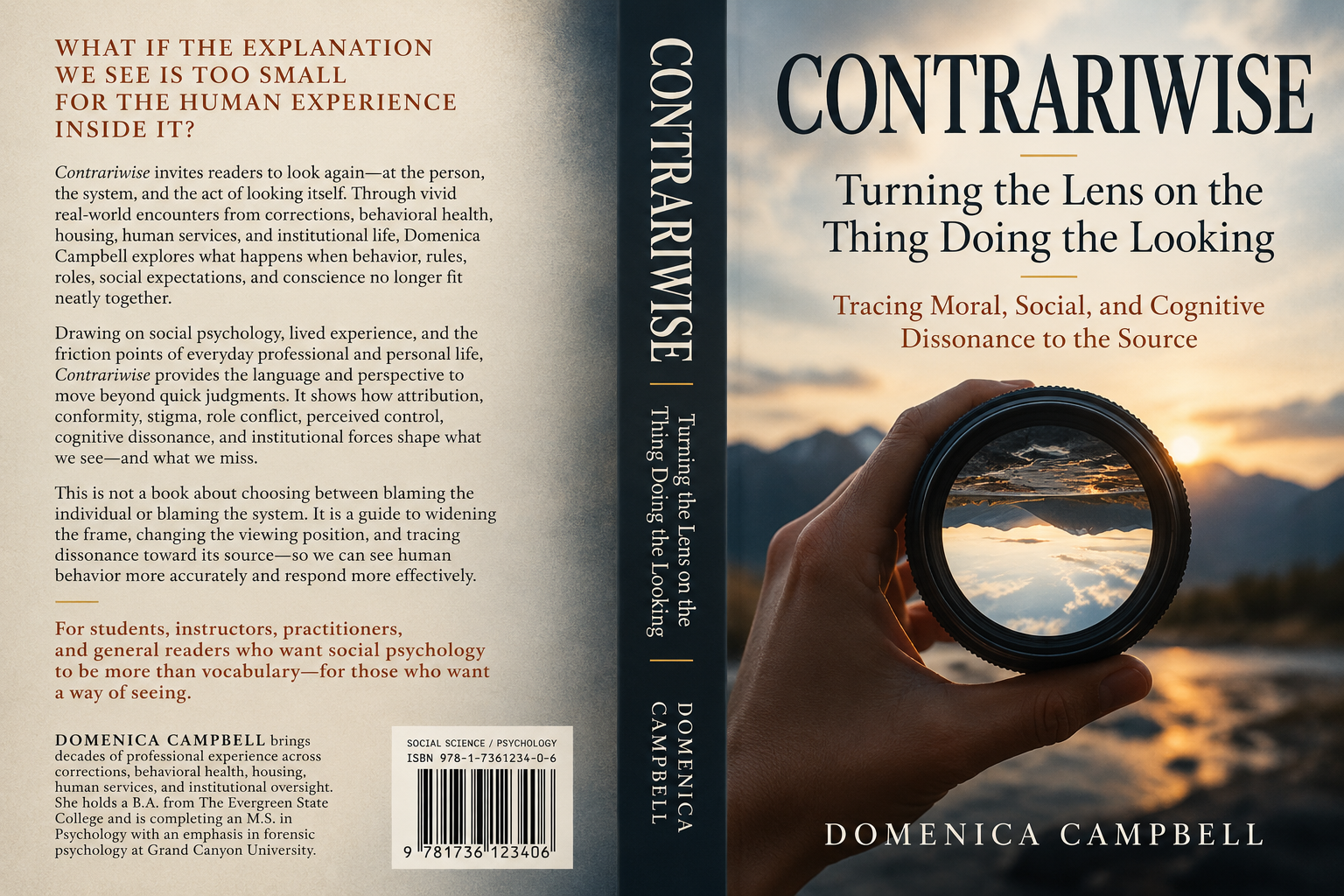
A book in progress about human behavior, institutional pressure, and the frames we mistake for the whole picture.
CONTRARIWISE: Turning the Lens on the Thing Doing the Looking brings practitioner experience into conversation with social and forensic psychology. It follows the questions running through this platform into sustained narrative and analysis.
The developing manuscript examines compliance, poverty, survival, the experience of doing institutional work, and the reconstruction of identity after incarceration. It asks how ordinary procedures acquire extraordinary consequences—and what becomes possible when we examine the assumptions carrying them.
The book is being written. This platform gives the inquiry room to develop alongside it.
Read the opening field notes